Paris Guides
French Revolution Sites in Paris: Where History Happened
From the Bastille to the Place de la Concorde: the places in Paris where the French Revolution happened, what you can still see today and a route to follow them.
In this article
Paris was the stage of the French Revolution. In a few years, between 1789 and 1794, its squares, palaces and prisons saw the fall of the Bastille, the end of the monarchy and the Terror. Many of these places still stand, sometimes under another name. Here are the essential French Revolution sites in Paris, in the order of the events, and how to link them on foot.
The French Revolution in 10 dates
- 5 May 1789: the Estates General open at Versailles.
- 14 July 1789: the storming of the Bastille.
- 26 August 1789: the Declaration of the Rights of Man and of the Citizen.
- 5 and 6 October 1789: the women of Paris bring the royal family back from Versailles.
- 14 July 1790: the Festival of the Federation on the Champ de Mars.
- June 1791: the royal family's flight ends with their arrest at Varennes.
- 10 August 1792: the storming of the Tuileries and the fall of the monarchy.
- 21 September 1792: the abolition of the monarchy; the Republic begins.
- 21 January 1793: the execution of Louis XVI.
- 27 July 1794 (9 Thermidor): the fall of Robespierre and the end of the Terror.
The Palais-Royal: the spark
On 12 July 1789, in the garden of the Palais-Royal, the young journalist Camille Desmoulins climbed onto a table outside the Café de Foy and called the crowd to arms. The arcades, cafés and bookshops of the Palais-Royal, owned by the king's cousin, were then the busiest meeting place in Paris, where pamphlets and news spread fast. Today the garden is one of the most peaceful corners of the city.
Les Invalides and the Bastille: 14 July 1789
On the morning of 14 July, the crowd took muskets and cannons from Les Invalides, then marched to the Bastille, a royal fortress and prison in the east of the city, in search of gunpowder. By the afternoon the fortress had fallen. Its demolition began almost immediately, and its stones were sold as souvenirs or used to build the Pont de la Concorde.
Nothing of the fortress stands on the Place de la Bastille today, but look down: a line of paving stones traces the outline of its towers near the start of the Rue Saint-Antoine, and the foundations of one tower were moved to the nearby Square Henri-Galli. The column in the middle of the square, crowned by the golden Spirit of Freedom, does not commemorate 1789 but the revolution of July 1830.

The Tuileries: the fall of the monarchy
In October 1789, the women of Paris marched to Versailles and brought the royal family back to the capital. Louis XVI and Marie-Antoinette were installed in the Tuileries Palace, next to the Louvre. On 10 August 1792, the palace was stormed and the monarchy fell. The palace itself burned in 1871, but its garden remains, between the Louvre and the Place de la Concorde.
The Conciergerie: the antechamber of the guillotine
During the Terror, the Revolutionary Tribunal sat in the Palais de Justice on the Île de la Cité, and its prisoners waited in the Conciergerie next door. Thousands left from here for the scaffold. Marie-Antoinette spent her last weeks in a cell of the Conciergerie in 1793; a chapel was later built on the site. Its vast Gothic halls, the oldest remains of the medieval royal palace, can be visited.
The Conciergerie stands a few steps from the Sainte-Chapelle and Notre-Dame: our Île de la Cité walking tour tells its story, from the palace of the kings to the prison of the Revolution.
Place de la Concorde: the guillotine
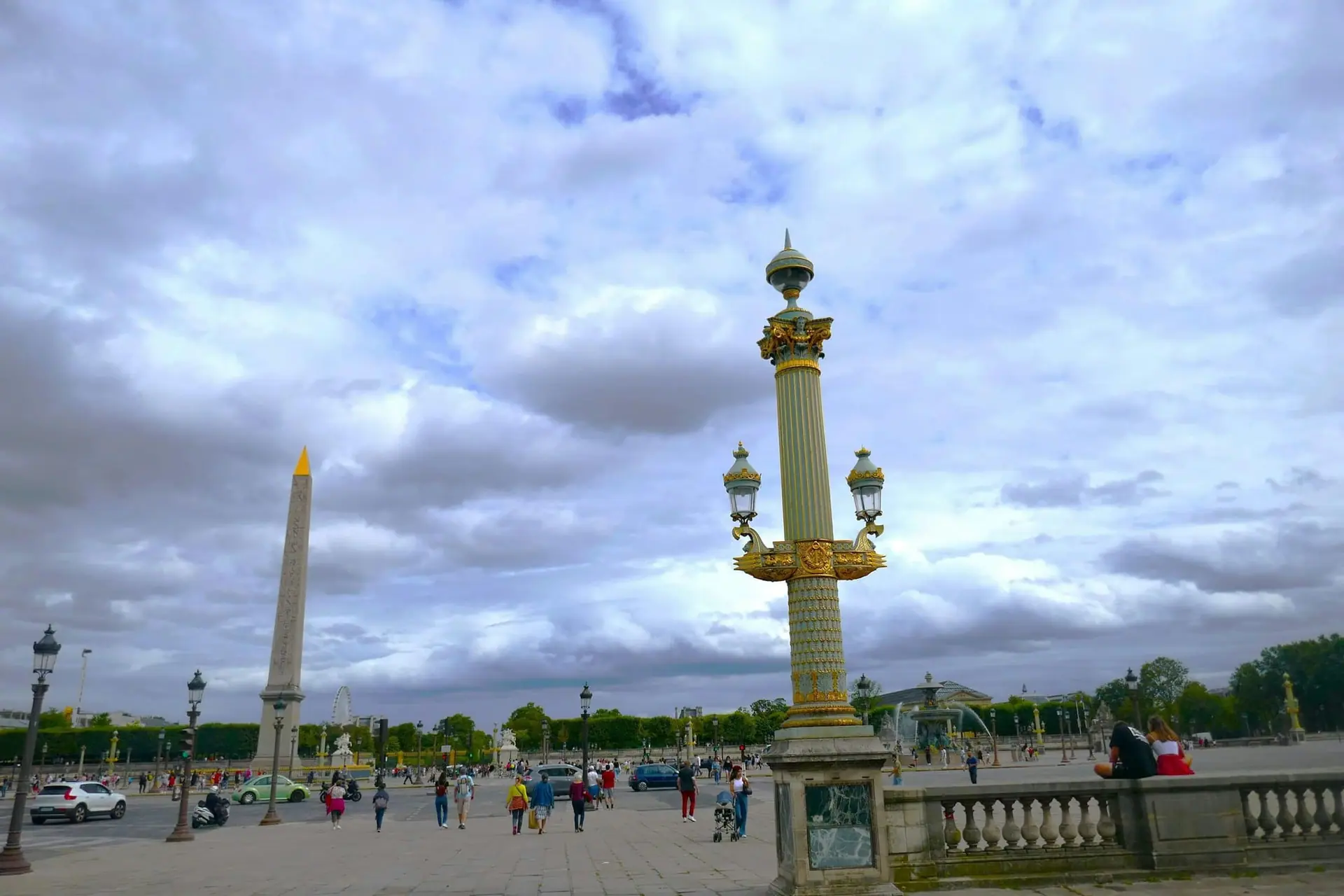
The largest square in Paris was called Place Louis XV, then Place de la Révolution. The guillotine stood here: Louis XVI was executed on 21 January 1793, Marie-Antoinette on 16 October 1793, followed by Danton and, in July 1794, Robespierre himself. Renamed Concorde to turn the page, the square received its Egyptian obelisk in 1836.
More places to follow the Revolution
- The Musée Carnavalet: the museum of the history of Paris, in the Marais, holds one of the richest collections on the Revolution, from models of the Bastille carved from its stones to portraits of its leaders. The permanent collections are free.
- The Hôtel de Ville: the seat of the revolutionary Paris Commune, where Robespierre was arrested in July 1794.
- The Panthéon: the church was turned into a temple for the great men of the nation in 1791; Voltaire and Rousseau were among the first to be laid to rest there.
- The Cour du Commerce-Saint-André: a cobbled passage of the Latin Quarter where Marat printed his newspaper, next to the Café Procope.
- The Chapelle expiatoire: built on the site of the cemetery where Louis XVI and Marie-Antoinette were first buried.
- The Picpus cemetery: the resting place of more than 1,300 people guillotined in the summer of 1794, and of the Marquis de Lafayette, whose grave flies the American flag.
A French Revolution walking route
Start at the Place de la Bastille, walk through the Marais to the Musée Carnavalet, then on to the Hôtel de Ville. Cross to the Île de la Cité for the Conciergerie, follow the Seine to the Louvre and the Tuileries Garden, and finish at the Place de la Concorde. Allow about half a day with visits, and wear comfortable shoes.
Since 1880, 14 July has been France's national day: if you are in Paris then, you will see the military parade on the Champs-Élysées in the morning and fireworks at the Eiffel Tower at night. To end the story at Versailles, where it all began, read our guide to visiting Versailles from Paris.
Frequently asked questions
What French Revolution sites can you visit in Paris?
The main ones are the Place de la Bastille, the Conciergerie, the Place de la Concorde, the Tuileries Garden, the Palais-Royal, the Panthéon, the Musée Carnavalet and the Picpus cemetery.
Is there anything left of the Bastille?
Very little. Paving stones trace the outline of its towers near the Rue Saint-Antoine, and the foundations of one tower can be seen in the Square Henri-Galli. Some of its stones were used to build the Pont de la Concorde.
Where was Marie-Antoinette imprisoned in Paris?
Marie-Antoinette spent her last weeks in 1793 in the Conciergerie, on the Île de la Cité, before her execution on the Place de la Révolution, today's Place de la Concorde.
Where was the guillotine in Paris?
The most famous executions, including those of Louis XVI and Marie-Antoinette, took place on the Place de la Révolution, now the Place de la Concorde. In the summer of 1794, the guillotine was moved to the east of Paris, near today's Place de la Nation.
Why is 14 July celebrated in France?
It recalls the storming of the Bastille on 14 July 1789 and the Festival of the Federation held a year later on the Champ de Mars. It has been France's national day since 1880.
Explore it in person
Tours for this part of Paris
Small-group and private tours with licensed local guides.
 Top rated
Île de la Cité Guided Tour & Exterior Notre Dame
Step into the birthplace of Paris and uncover centuries of fascinating history on an unforgettable guided walking tour of Île de la Cité. Accompanied…

Protest History Walk: from Bastille to Republiqué
Ever wondered what’s really going on, and why Parisians keep taking to the streets? Who are the peaceful marchers, and who are the people breaking…
 Summit access
Eiffel Tower Guided Tour to Summit
Discover Paris from one of the world’s most iconic landmarks with a guided Eiffel Tower experience designed for small groups. With entry tickets…
The Journal
Keep reading
Paris Guides
Musée d'Orsay Guide: 10 Masterpieces and Tips for Your Visit
The Impressionist masterpieces you should not miss at the Musée d'Orsay, the story of the old railway station, the best time to go and how to plan your visit.
Paris Guides
Sainte-Chapelle, Paris: How to Visit the Jewel of Gothic Stained Glass
How to book the Sainte-Chapelle, the best time for the light, how to read its 15 stained-glass windows and what to see nearby on the Île de la Cité.
Paris Guides
Napoleon's Tomb and Les Invalides: The Complete Visitor's Guide
Napoleon's tomb under the golden dome, the highlights of the Army Museum, how tickets work and how long to allow for a visit to Les Invalides in Paris.